As the 2026 FIFA World Cup brings millions of international travellers to the United States, airports are once again preparing for the operational challenge of moving unprecedented passenger volumes efficiently. While today’s technologies are far more advanced, the industry’s response echoes a pivotal moment more than four decades ago.

In 1984, Los Angeles faced a similar challenge as it prepared to host the Olympic Games. Airline check-in infrastructure was fragmented: each carrier operated dedicated counters powered by proprietary systems, leaving valuable capacity underutilized while passengers queued elsewhere.
The solution was revolutionary for its time.
The introduction of Common Use Terminal Equipment (CUTE) allowed multiple airlines to share the same check-in infrastructure, fundamentally changing airport operations. That innovation laid the foundation for what later evolved into Common Use Passenger Processing Systems (CUPPS), followed by technologies such as Common Use Self Service (CUSS) and Self Bag Drop (SBD).
Together, these technologies defined the modern passenger processing paradigm. They standardized fragmented infrastructure, reduced operational complexity, and enabled airports and airlines to handle ever-growing passenger volumes with remarkable efficiency.
Their objective was clear:
Process passengers faster.
And for decades, that objective shaped nearly every investment in passenger-facing airport technology. It was the right solution for its time. But it was designed for an era in which passengers were primarily viewed as a flow problem to optimize.
Today, airports operate in a very different environment. Passenger expectations have evolved, commercial revenues have become increasingly critical, and operational complexity continues to grow.
This raises a fundamental question:
Are passenger touchpoints simply operational bottlenecks to optimize, or are they intelligence and revenue opportunities waiting to be unlocked?
The answer may define the next generation of airport technology.
From Processing to Understanding
Today’s passenger processing systems remain exceptionally good at what they were designed to do: reducing friction.
Check-in kiosks accelerate transactions. Self bag drop automates baggage acceptance. eGates verify identities and boarding credentials within seconds. Yet despite their sophistication, these systems remain fundamentally transactional.
A kiosk does not recognize that a traveller is running late and may benefit from fast-track security. A boarding gate does not identify a passenger who has time to visit a lounge or take advantage of a last-minute retail offer. Processing points rarely understand the broader context of the passenger journey.
In other words, airports have become highly efficient at moving passengers—but far less capable of understanding them. That distinction matters.
For many airports, non-aeronautical revenues account for more than 40 percent of total income. Every passenger interaction represents not only an operational event, but also an opportunity to improve the journey, increase customer satisfaction, and generate commercial value.
Biometrics Solved Identity. AI Solves Intelligence.

Much of today’s industry conversation revolves around biometrics. Major technology providers continue to expand their portfolios through investments in identity management, self-service, and passenger automation.
Biometrics undoubtedly improve identity assurance while reducing friction throughout the passenger journey. But identity alone is no longer enough.
Knowing who the passenger is does not necessarily reveal:
- what they need,
- what services are most relevant,
- what they are likely to purchase,
- where operational intervention may be required, or
- how their experience could be improved in real time.
Identity answers who.
AI begins to answer what next.
This represents an entirely new architectural layer in passenger processing.
Instead of simply executing transactions, passenger touchpoints can become intelligent decision points capable of interpreting context, anticipating needs, and orchestrating personalized interactions across the airport ecosystem.
This is a far more profound transformation than another incremental automation project. It represents a shift from processing passengers to understanding them.
Intelligent Touchpoints: The Next Generation of Passenger Processing
Imagine every passenger touchpoint operating not merely as infrastructure, but as an intelligent service node. Rather than performing a single transaction, each interaction could continuously evaluate passenger context, detect behavioural patterns, and recommend the most relevant operational or commercial action.
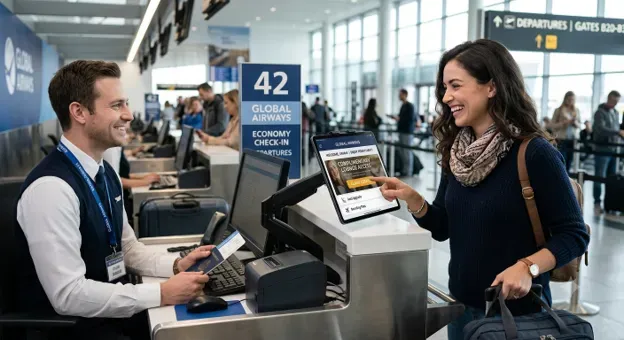
This creates value across several dimensions:
Reimagining Self-Service Infrastructure
As passenger expectations evolve, so too must self-service infrastructure.
The next generation of passenger processing touchpoints—from CUPPS workstations and CUSS kiosks to Self Bag Drop (SBD), Self Boarding Gates (SBG), and eGates—will do far more than execute transactions or verify credentials.
They will become intelligent orchestration points capable of managing access control, eligibility verification, ancillary service activation, passenger flow optimization, and real-time operational decision support.
When integrated with CUPPS, Airport Operational Databases (AODB), airline systems, and AI orchestration platforms, these touchpoints become intelligence gateways rather than simple access control devices.
Importantly, this transformation no longer depends on large-scale infrastructure replacement.
Software-defined, modular, AI-enabled platforms are reducing deployment costs and making advanced passenger technologies accessible not only to major international hubs, but also to regional and mid-sized airports.
Operational Intelligence & Disruption Management
Every passenger interaction generates operational intelligence yet much of that intelligence remains unused.
Intelligent kiosks, eGates, bag drop systems, and processing points can collectively provide a live operational picture of the terminal, including congestion patterns, passenger flows, baggage behaviour, service uptake, and traveller segmentation.
Instead of isolated processing events, airports gain a continuously evolving intelligence layer that supports operational decision-making across the entire ecosystem.
AI can also address operational challenges that directly affect both efficiency and revenue.
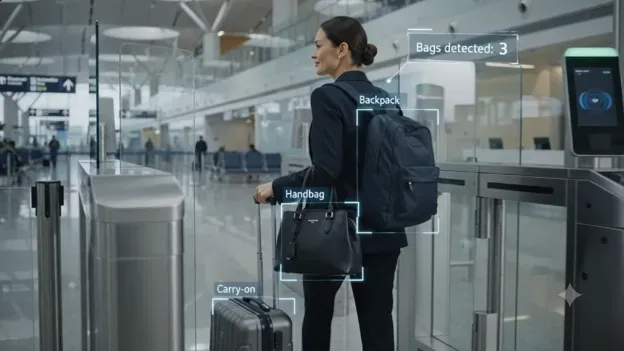
For example, cabin baggage overflow remains a common source of boarding delays and aircraft turnaround inefficiencies. Computer vision integrated into passenger touchpoints could identify oversized or excessive carry-on baggage well before boarding, allowing airports and airlines to proactively offer cabin baggage upgrades, transfer bags to the hold, balance cabin capacity, and reduce gate congestion.
The result is not simply a better passenger experience, but measurable protection of both operational performance and ancillary revenue.
Hyper-Personalized Passenger Services
Historically, airports have had limited ownership of passenger relationships. Airlines possess customer profiles, loyalty data, and travel history, while airports often interact with passengers only during individual operational transactions.
AI begins to close that gap.
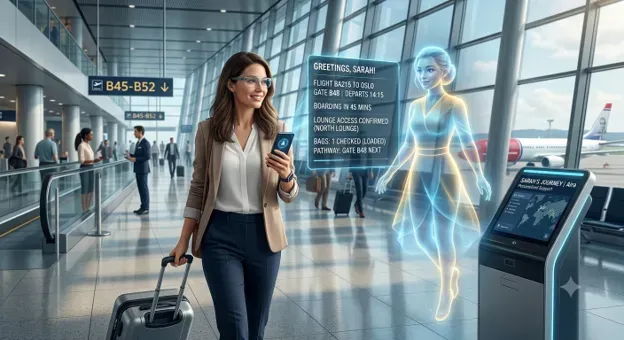
A traveller arriving late could automatically receive a fast-track security offer. Families travelling with young children could be guided toward buggy services, family lounges, or priority screening. Transit passengers facing long layovers could be presented with sleeping pods, hotel access, or premium lounge packages. Passengers approaching retail zones might receive contextual recommendations for dining, duty free, or mobility services based on their remaining dwell time.
The shift is subtle but significant.
It moves airports away from generic promotions and toward situational, context-aware engagement where relevance drives conversion.
The Airport Concierge at Scale
For decades, concierge-level assistance has been reserved for premium travellers. AI changes that equation.
For the first time, airports can deliver personalized assistance at scale. Rather than replacing frontline staff, AI augments them through a AI-powered advisory layer embedded across check-in counters, kiosks, eGates, bag drop stations, and mobile applications.
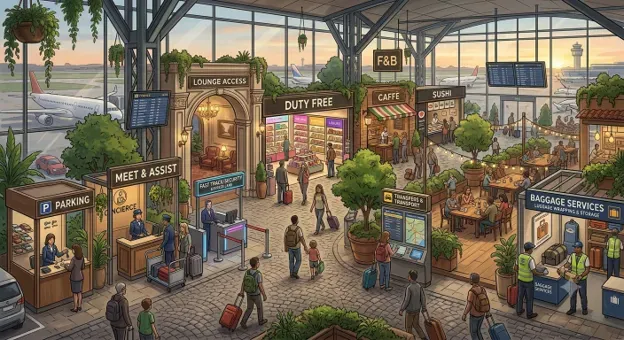
Passengers receive guidance precisely when they need it, while airports surface relevant services throughout the journey.
This is particularly important because airport ecosystems remain highly fragmented. Parking, lounges, retail, transportation, fast-track security, food and beverage, and meet-and-assist services frequently operate in separate commercial silos.
The consequence is low service discoverability and missed revenue opportunities.
The future requires orchestration rather than fragmentation.
Conclusion
Next Decade: From Infrastructure to Platform
In 1984, the airport industry reinvented passenger processing by introducing shared infrastructure. That innovation transformed how airports handled growing passenger volumes for the next four decades.
Today, the challenge is no longer simply processing more passengers.
It is understanding them.
The next ten years will be about optimizing value.
Value per interaction. Value per passenger. Value per journey.
The winners in this new landscape will not simply be those who process passengers faster. They will be those who understand passengers better. And in an AI-native airport ecosystem, every touchpoint; from check-in to boarding; becomes an opportunity to do exactly that.
What is emerging is not another layer of optimization, but a structural transformation in how airports interpret, respond to, and monetize the passenger journey itself.
This is the shift:
- From infrastructure to intelligence.
- From transactions to interactions.
- From systems to ecosystems.
And as this shift accelerates, the industry will experience a clear leap not just in capability, but in mindset.
A leap from static passenger processing to adaptive passenger experience systems that learn, predict, and act in real time.
What comes next will redefine how airports think about value creation entirely.
For now, it is enough to say this: the foundations of that future are already being built.
This article was originally published by TAV Technologies, where it appears in full.