A UK-led consortium has launched a 30-month programme to test whether artificial intelligence can help commercial aircraft avoid atmospheric conditions that contribute to persistent warming contrails.
Operation Blue Skies is backed by 2.65 million GBP in funding from the UK Department for Transport through the Aerospace Technology Institute (ATI) Programme. The overall programme is valued at 5 million GBP and brings together Google UK, the Department for Transport, the Met Office, NATS, Contrails.org, Imperial College London and the University of Cambridge.
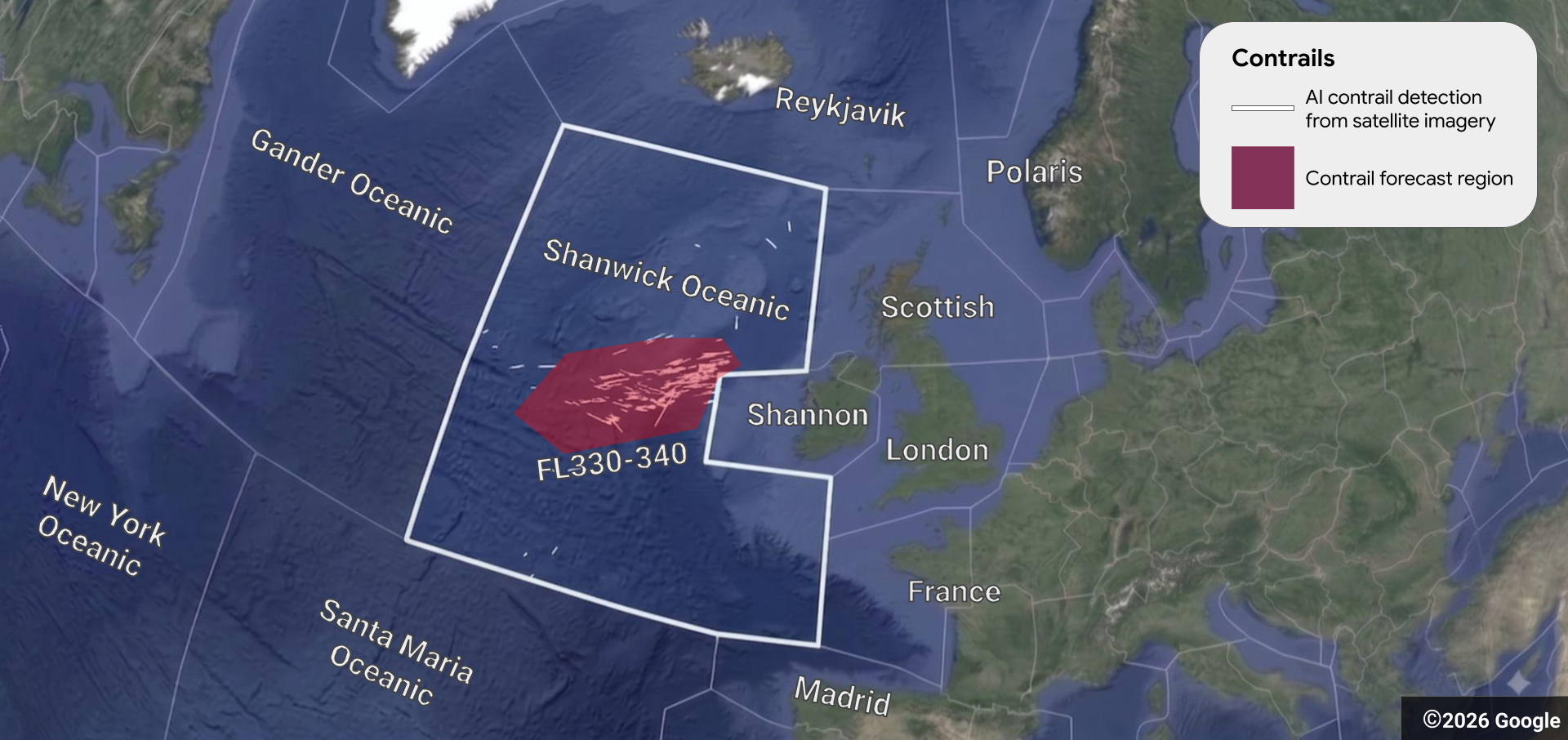
The programme will conduct two operational trials in NATS-controlled Shanwick oceanic airspace, which covers the eastern part of the North Atlantic corridor. Testing is scheduled to take place during the winters of 2026-27 and 2027-28, with around 20 to 40 test days planned during each winter.
The trials will assess whether small changes to aircraft altitude can reduce the formation of persistent contrails without disrupting normal air traffic operations. The adjustments will be coordinated through existing air traffic control procedures.
Contrails form when water vapour in aircraft exhaust freezes around particles in cold, humid air at cruising altitude. Some persistent contrails can spread and form ice-crystal clouds that have a warming effect on the climate.
According to the programme partners, modelling indicates that Shanwick airspace accounts for approximately 5% of global contrail warming, with a significant proportion occurring between November and February. Operation Blue Skies will therefore concentrate its testing during the winter period, when the potential climate impact is considered highest.
AI models will be used to identify atmospheric conditions where changes to flight altitude could reduce the likelihood of persistent warming contrails. Satellite imagery and other data will then be used to assess the results of the interventions.
Google UK will contribute 1.4 million GBP of in-kind support to the programme, including AI research, engineering expertise and access to high-performance computing infrastructure. The company is participating on a pro-bono basis.
NATS will manage the operational aspects of the trials, including airspace operations, air traffic control coordination, safety assessments and controller training. The Met Office will develop a UK contrail forecasting capability to support the testing.
Contrails.org will assess and integrate forecasts, help establish the trial parameters and contribute to data analysis. Researchers at Imperial College London and the University of Cambridge will independently evaluate the results and assess the climate impact of the trials.
Keir Mather, UK Minister for Aviation, Maritime and Freight, said:We’re partnering with Google to back British experts and innovators to find practical ways to make flying cleaner. This is a world-first, and it’s British ingenuity leading the way. By testing small tweaks to flight paths over the Atlantic, we can cut the vapour trails left behind by planes.
From £219 million for home-grown sustainable fuel to zero-emission aircraft, we’re backing innovation to make UK aviation cleaner, support thousands of skilled jobs, and drive growth in the sector.
The government has also committed 219 million GBP to projects intended to increase UK production of sustainable aviation fuel, alongside investment in other aviation technologies.
Operation Blue Skies intends to provide operational evidence on whether contrail avoidance can be implemented safely and consistently within the existing air traffic management system.
NATS Director of Sustainability Ian Jopson said:Decarbonising aviation will take a range of solutions, and understanding the role of contrails is an important part of that journey. This trial will allow us to test how contrail avoidance could work within the complex, highly coordinated environment of air traffic management.
By bringing together world-leading science and operational expertise, we can start to build the real-world evidence needed to understand whether this could make a meaningful contribution to reducing aviation’s overall climate impact.
The trials will be conducted during periods of lower air traffic, allowing the consortium to assess the technology and operational procedures before considering how the approach could be applied more widely.