A new technical report has confirmed that hydrogen-powered ground support equipment (GSE) can be integrated into airport operations, following the UK’s first airside trial involving multiple hydrogen technologies.
The Zero Carbon Turn project was led by Exeter Airport in collaboration with Cranfield University, TUI, ULEMCo, Boeing and MULAG. The work was supported by the Civil Aviation Authority through its Hydrogen Challenge Sandbox programme.
The project brought together three hydrogen-powered technologies to support the turnaround of a TUI Boeing 737 at Exeter Airport. Its aim was to demonstrate and evaluate hydrogen equipment in an operational airport setting and to build evidence for future hydrogen use in aviation.
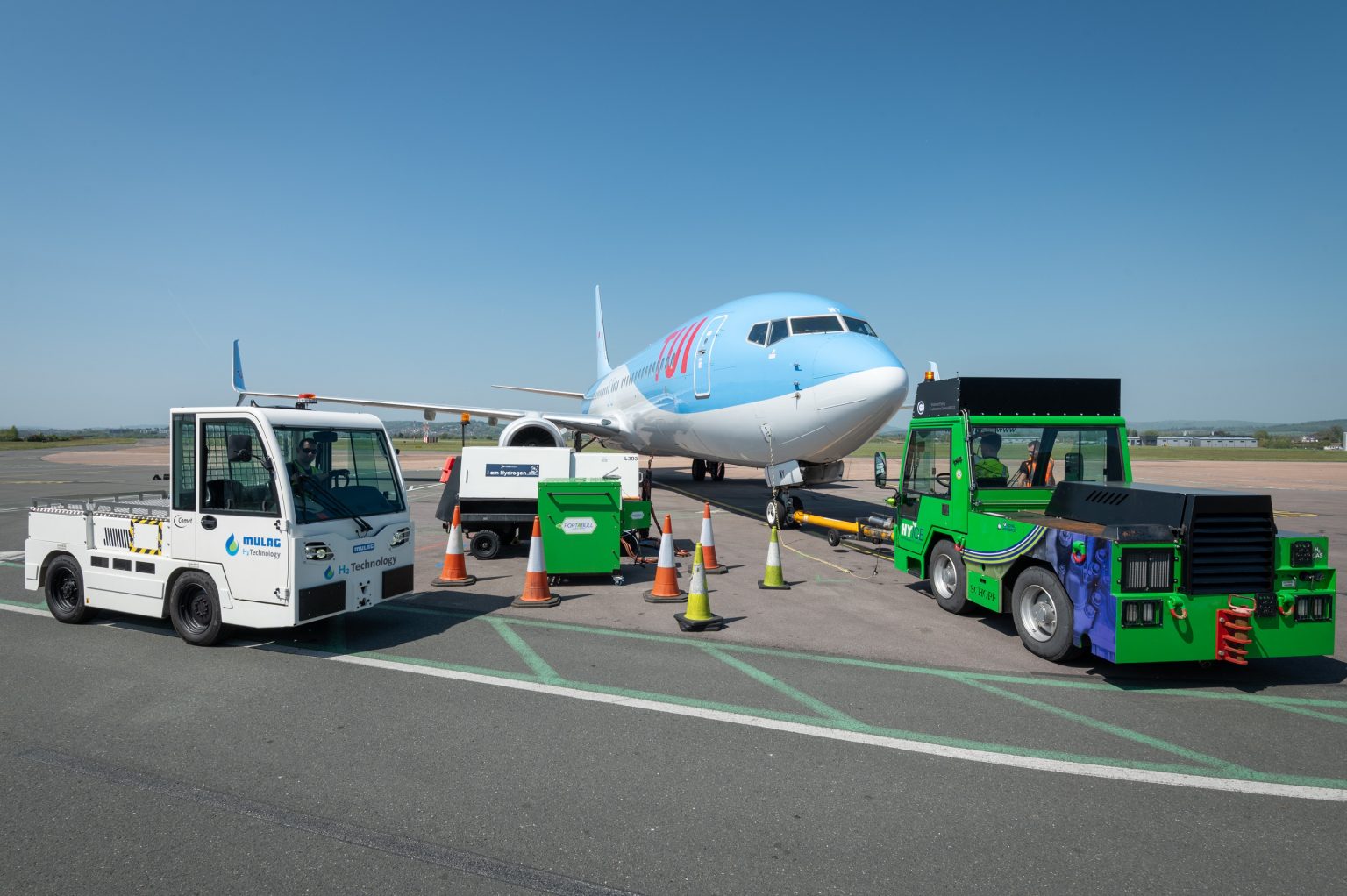
The trial involved the coordinated use of a hydrogen internal combustion tug, a hydrogen fuel cell baggage tractor and a hybrid hydrogen–diesel ground power unit (GPU). Researchers reported that the equipment operated together airside without safety incidents, marking a number of UK firsts.
Among the milestones identified were the concurrent use of multiple hydrogen-fuelled GSE units at a UK airport, the use of a hydrogen-powered GPU to supply power to a commercial aircraft, and the deployment of a hydrogen aircraft tug with a passenger aircraft. The project also included the use of green hydrogen produced via electrolysis using renewable energy.
Although hydrogen-powered aircraft are not yet in regular commercial service, the report notes that groundwork is required in regulation, infrastructure and operational knowledge to support future adoption.
Further Testing
A follow-up trial is scheduled at Exeter Airport later this month in partnership with Cranfield University and ULEMCo. The study will simulate a series of aircraft turnarounds using a hydrogen-powered GPU in winter conditions. Funding has been provided by Connected Places Catapult.
Researchers say the winter trial will provide additional data on how hydrogen systems perform under seasonal operating conditions.
Stephen Wiltshire, Managing Director of Exeter Airport, which is part of the Regional & City Airports group, said:The Exeter trial has proven that hydrogen ground equipment works – and works safely – in a real operational environment. As the report highlights, regional airports like ours will be among the first to handle hydrogen-powered aircraft, and we are natural testbeds for developing these technologies. The priority now is to build on this progress. Our winter trial this month is an important next step in strengthening the evidence base for wider hydrogen adoption across UK aviation.
Cranfield University’s report on the Zero Carbon Turn project sets out key lessons and identifies areas requiring further work. It suggests that airports could adopt hydrogen technologies in the short term as part of wider decarbonisation efforts, but calls for more extensive trials.
The report highlights several priorities for future work, including longer-duration trials in operational settings, evaluation of alternative storage and refuelling models, creation of a formal knowledge-sharing platform and refinement of regulatory processes to support additional demonstrations.
Dr Thomas Budd, Associate Professor of Airport Decarbonisation, Cranfield University, and author of the report, said:This project delivered several UK firsts, but its greatest value lies in what it tells us about the road ahead. To prepare for hydrogen-powered aircraft and large-scale adoption of hydrogen GSE, the industry must expand research to further real-world conditions, explore storage and refuelling approaches and formalise knowledge-sharing across the sector. Airports want to decarbonise and GSE manufacturers are rising to the hydrogen challenge, but there is a pressing need to bridge the infrastructure gap.