Aviation security is one of those disciplines where the “headline moments” get most of the attention, but day-to-day performance is built on quieter fundamentals: consistent processes, good judgment under pressure, and communications that still work when the environment gets noisy, fast, and complex. In that context, body-worn cameras and two-way radios aren’t just another tool on a kit list. Used well, they support clearer decision-making, better coordination, and stronger post-incident learning – without getting in the way of operational flow.
Aviation security history
When people talk about aviation security history, the story is often told as a series of accelerations: incidents expose vulnerabilities, standards evolve, and airport operations adapt. A key milestone was the adoption of ICAO’s aviation security standards (Annex 17), developed in response to unlawful interference, including hijackings, and then embedded internationally.
The post-2001 environment brought another major shift, with significant changes at checkpoints and in wider airport access controls. Even airports themselves summarise how different the passenger experience (and screening posture) was immediately before 11 September 2001 compared with what followed. The practical takeaway for today’s teams is that aviation security has always been a moving target – procedures, threats, and expectations evolve, but the need for reliable, real-time coordination remains constant.
Aviation security risks and threats
Today’s aviation security challenges go way beyond checkpoint threats. Many airports manage a wide mix of risk types across landside and airside environments, including:
- Unlawful interference and terrorism-related threats (from attempted attacks to reconnaissance and probing of procedures)
- Insider risk (trusted access abused, intentionally or through coercion)
- Disruption and disorder (conflict, aggression, or crowd-management pressure points)
- Operational knock-on effects (a localised incident quickly becoming a safety and service issue across multiple teams)
This is where evidence capture and communications intersect with security outcomes: it’s difficult to contain an incident – or learn from it – without a clear record and a shared, timely picture of what’s happening.
Aviation security training
Aviation security training is most effective when it reflects the reality of the job: variable context, multiple stakeholders, and decisions made with incomplete information. Alongside regulatory and role-specific requirements, many airports get the most value from training approaches that emphasise:
- Scenario-based practice (including multi-team coordination: security, operations, airlines, concessions, and responders)
- Human factors and communication discipline (how messages are framed, confirmed, and escalated under stress)
- Incident review loops that translate “what happened” into improvements in procedure, layout, staffing, and technology
In practice, training quality often depends on the tools available to reconstruct events and validate decisions – this is where body-worn footage and radio logs can materially improve the debrief process, without relying solely on memory.
Aviation security equipment
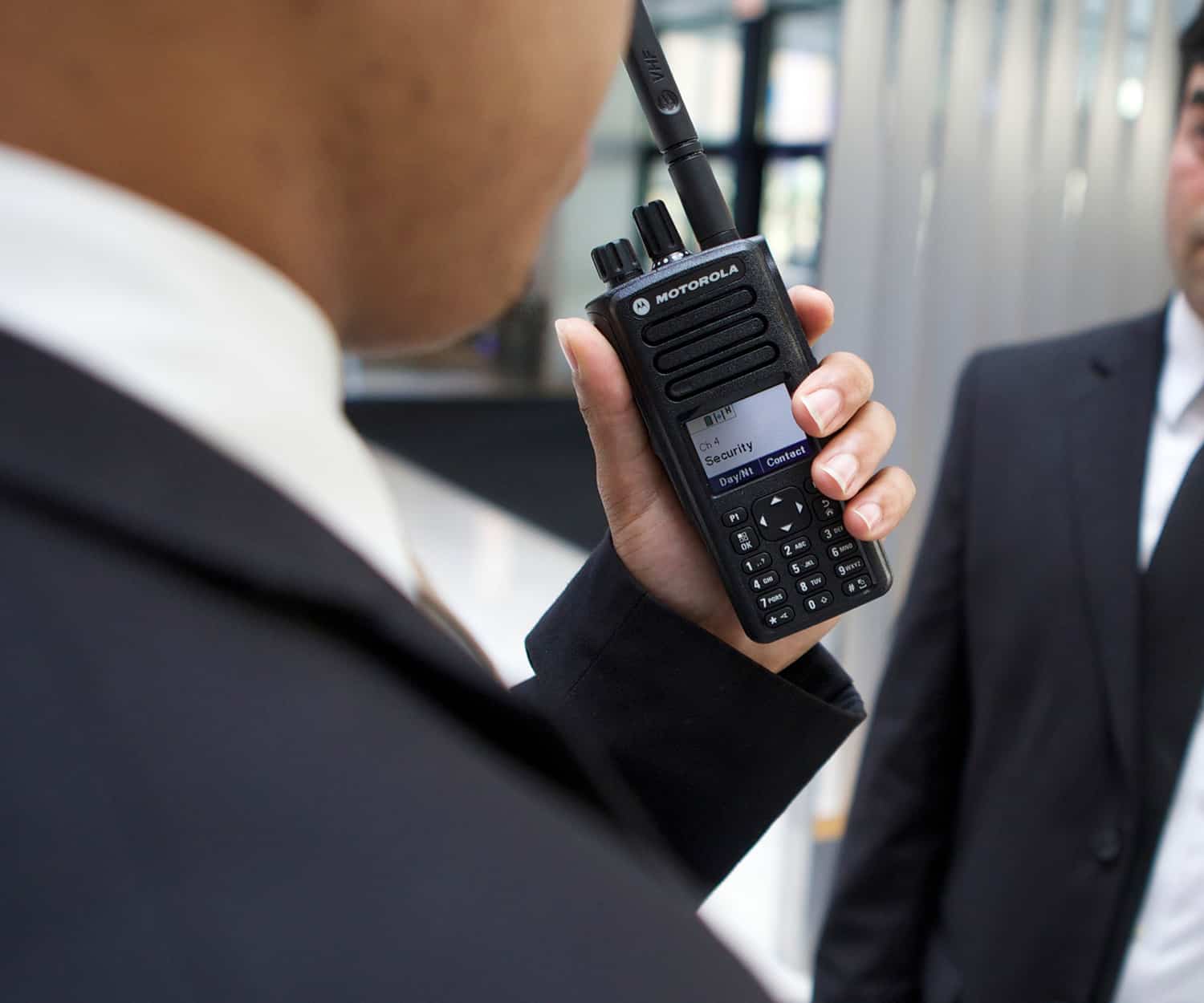
The phrase “aviation security equipment” can bring screening lanes and access control to mind first, but in many airports the day‑to‑day backbone is still business critical comms and incident‑ready evidence capture. That’s why a multi layered set‑up often sits behind the scenes: robust two‑way radio for instant group calls, optional fixed mobiles in vehicles, offices or control rooms, and more advanced systems that can share locations, issue work tasks, or integrate with other site technologies such as alarm systems.
Radiocoms brings technologies together through an ‘into one’ approach – creating a centralised platform and analytics to support teams landside to airside including airlines, service providers, catering, cargo and concessionaires – so that information and responses don’t get stuck in silos when pressure is on.
One area worth mentioning is BBPTT (Broadband Push-to-Talk) – push-to-talk communications delivered over 3G/4G/Wi-Fi networks, enabling wide-area or even multi-site connectivity without losing the simplicity of “press-to-talk” group comms. For aviation environments that need both local resilience and broader coverage (for example, multi-terminal operations, remote stands, off-airport facilities, or contractor coordination), BBPTT can complement traditional radio networks rather than replace them.
Body-worn cameras in aviation security
Body-worn cameras can influence aviation security outcomes in three practical ways:
- De-escalation and behaviour effects: When deployed thoughtfully, cameras can support calmer interactions and reduce disputes about what happened.
- Evidence and transparency: Footage provides an objective record to support investigations, complaint resolution, and learning reviews – particularly where accounts of events differ.
- Training feedback: Real footage (handled correctly) can support reflective practice – helping teams review communication, positioning, and decision points without relying on hindsight narratives.
Of course, aviation settings raise legitimate governance questions: privacy, signage, retention, access controls, and clear rules on when recording is appropriate. The operational principle is simple: clear policy, consistent practice, and secure handling are what make the technology defensible and useful.
Two-way radios in aviation security
Two-way radios remain foundational in airports because they solve a simple problem exceptionally well: instant group communication in environments where seconds matter and teams are distributed across large footprints.
From a security perspective, the value often shows up in the “in-between moments”:
- Rapidly coordinating a response without tying up phone lines
- Managing an incident while keeping routine operations moving
- Discreet, role-based talk groups (security, ops, engineering, airline handling, etc.)
- Maintaining communications where mobile coverage is inconsistent or overloaded
Pulling it together in a real airport environment
The most effective deployments treat cameras and radios as part of a joined-up operating model:
- Two-way radios and/or BBPTT provide the shared, immediate operational picture.
- Body-worn cameras help capture interactions and decision points, supporting professional standards and post-incident learning.
- Training and governance ensure the tech supports judgment – rather than replacing it.
If you’re exploring how body-worn cameras, two-way radios, or BBPTT could fit into your aviation security environment (including multi-team integration across landside/airside stakeholders), contact Radiocoms today to help you map requirements and design an approach that works in practice – not just on paper.
This article was originally published by Radiocoms.