The design of large-wingspan electric aircraft raises a challenge that has little to do with charging plugs — and everything to do with how we use the space on the apron.
By Job de Vries (TU Delft), Niek van Amstel (NACO) & Pieter van den Berg (Elysian Aircraft)
When people picture the challenges of electric aviation, they tend to think about batteries and charging infrastructure. But these are not the only relevant questions. There is a more immediate, and perhaps more surprising, challenge lurking in the geometry of the apron itself.
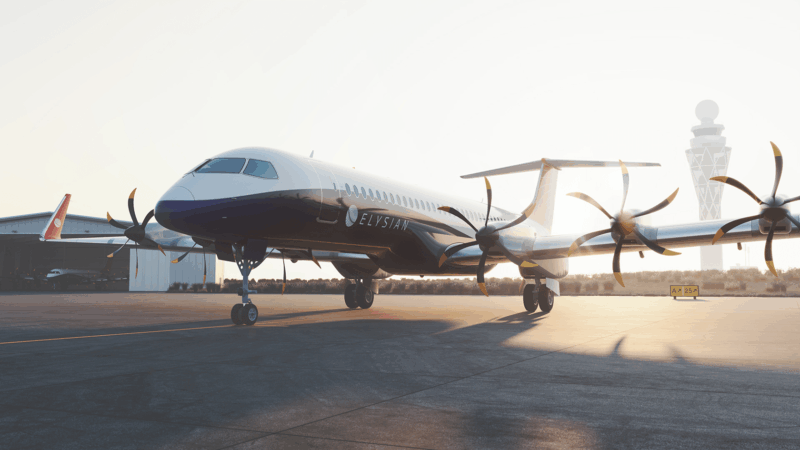
The Elysian E9X is a battery-electric aircraft designed to carry 90 passengers up to 800 km — a range that would cover the vast majority of short-haul routes in Europe and Asia. To achieve this with batteries, the aircraft needs an unusually long wingspan: just under 52 metres. That wingspan puts the E9X in the same size category as widebody aircraft like the Boeing 757 & 767, even though it carries the passengers of a regional turboprop.
This study assesses how well today’s airport aprons can accommodate large-wingspan electric aircraft, using the Elysian E9X as a case study across airports in Europe and South Korea.
Why Wingspan Creates an Airport Problem
Airport stands are designed around established links between aircraft size, wingspan and passenger capacity under the ICAO aerodrome reference code system. Most short-haul aircraft fall into Code C, while long-haul widebodies use Codes E and F, and airports have been optimized accordingly.
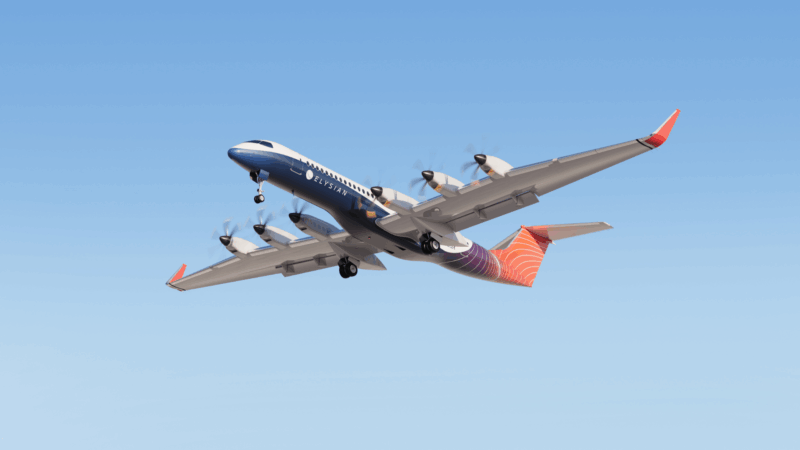
Aircraft, such as the Elysian E9X, challenge this logic: despite carrying a regional passenger load, its long, high-aspect-ratio wings place it in Code D, where capacity has declined as older aircraft retire. This reflects a broader shift in non-fossil aircraft design, which is breaking the traditional link between passenger capacity and wingspan and exposing tension between future aircraft and current airport infrastructure.
What the Numbers Say: How Much Code D Capacity Is Actually Out There?

When Are Stands Actually Free? The Peak Capacity Picture
A compatible stand is only part of the challenge. Availability varies across the day, especially at major hubs where peak periods of constrain capacity and wider stands are prioritised for long-haul aircraft. For the E9X, this means operations may be possible, but often time-restricted and inflexible, especially early in service.
Regional airports present a more favourable picture. Widebody stand capacity is often underused throughout the day, making them a natural starting point for large-wingspan electric aircraft. For small initial fleets, they offer both capacity and scheduling flexibility, though operations may still rely more on remote than contact stands during peak periods.
Regional airports maintain significant underutilisation throughout the day — making them the most natural early entry point for E9X operations.
Smart Solutions: Rethinking the Apron Layout
The study doesn’t stop at identifying the problem; it also explores how existing airport aprons could be used more efficiently to accommodate the E9X, without major construction or terminal expansion. Both proposed approaches build on a defining characteristic of the aircraft: while its wingspan is comparable to that of a widebody, its fuselage length is closer to that of a narrowbody.
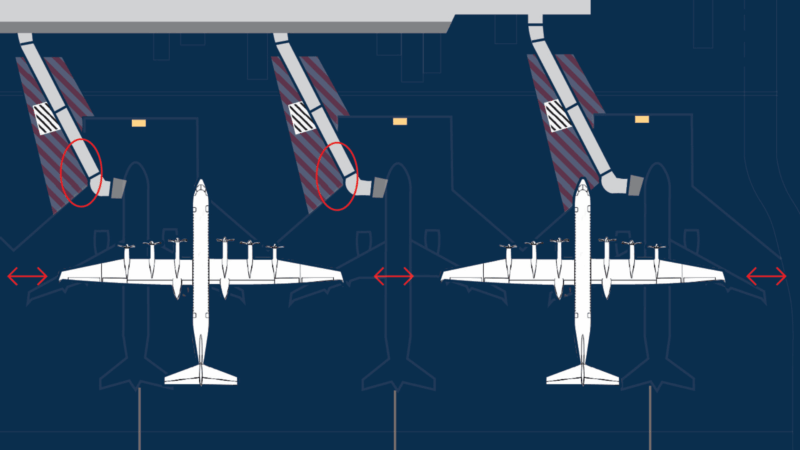
Converting Three Code C Stands into Two Code D Positions (3C/2D MARS)
The E9X challenges standard stand planning logic. Although it requires widebody clearances due to its wingspan, its short fuselage keeps the overall footprint compact. As a result, existing narrowbody stands can be temporarily reconfigured into fewer widebody-compatible positions and later reverted, enabling flexible use of existing apron space without permanent redesign.
Stacked PIPO configurations: using alternating orientations
A second, more innovative option explored in the study involves so-called Power-In Power-Out stands, where aircraft taxi through the stand rather than reversing out. By parking adjacent E9X aircraft in alternating orientations, required wing clearances can be achieved within a smaller overall footprint, allowing existing stands to accommodate more Code D aircraft than conventional layouts would permit.
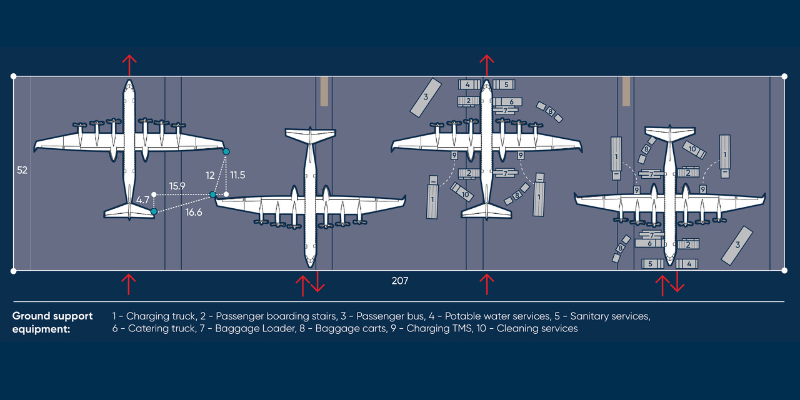
This approach again exploits the E9X’s relatively short fuselage, which creates sufficient longitudinal space to interlock aircraft without conflict. While geometrically feasible, such configurations would introduce new operational considerations, including the need for controlled reverse movements into some stands, potentially using conventional tugs or future autonomous taxiing solutions. As a result, the primary challenge is not spatial feasibility but regulatory approval, as aviation authorities would need to assess and certify novel ground-handling procedures before such layouts could be adopted at scale.
Civil aviation authorities, particularly in Europe, tend to be conservative when approving new ground operational procedures. Novel stand configurations, especially those involving reverse taxiing or new MARS arrangements, would require safety studies and formal regulatory approval; a process that could take years and introduce meaningful uncertainty for an aircraft programme already navigating a complex entry into service.
The strategic question: who should adapt?
All of the above leads to a choice that the industry will ultimately have to make — not just for the E9X, but for any future sustainable aircraft with a large wingspan.
Scenario A: Airports adapt to the aircraft
Airports implement MARS reconfigurations and new operational procedures to accommodate full-span E9X operations. The aircraft performs at its aerodynamic optimum; airports bear the cost of adaptation.
✓ Better flight performance, higher decarbonization potential
✓ No added aircraft complexity
✗ Market access depends on airport decisions
✗ Regulatory timelines uncertain
✗ Airports unlikely to act before commercial proof
Scenario B: The aircraft adapts to airports
The E9X adopts folding wingtips, reducing its operative wingspan to Code C at ground level. This provides immediate access to the most abundant stand type at all target airports worldwide.
✓ Immediate market access everywhere
✓ Route network within developer’s control
✗ Added mechanical complexity and mass
✗ Maintenance and certification challenges
✗ Fixed wingspan of 36 m limits range to ~400 km
In practice, these two paths are not mutually exclusive. The fundamental distinction lies in where risk is placed: with airports and regulators, or within the aircraft design itself.
Timing also plays a critical role. While existing Code D capacity and underutilised widebody stands at regional airports may be sufficient during early operations, a clear long-term strategy will be required as fleets scale and network ambitions expand.
A question for the whole industry
The E9X is a case study, but the challenge it illustrates is not unique to a single aircraft type or manufacturer. As sustainable flight technologies mature, aircraft designers are increasingly driven towards longer wingspans to achieve the required increased efficiency, putting pressure on airport infrastructure that remains calibrated to the dimensions of fossil-fuel aircraft.
The study shows that addressing this challenge does not necessarily require rebuilding airport aprons from scratch. With smarter use of existing space and a willingness by airports and regulators to adapt operating practices, infrastructure designed for yesterday’s aircraft does not need to become a barrier to the aircraft of tomorrow.
This article was originally published by NACO.