Beyond routine runway inspection for maintenance, XenomatiX customers also use 6D Road Scanning data to gain insights on the pavement surface, to support the reconstruction of a new runway structure.
New runways are designed with multiple layers and require precise control of geometry, smoothness, and surface performance per layer throughout the construction, to obtain at the end the strict quality requirements for runways.
XenomatiX reproduces the digital model of the runway asphalt layer by layer, providing detailed information on condition and locations of cracks and pavement-quality indicators, like:
- IRI score
- Protrusions and depressions: Identifying surface irregularities and preventing areas where water can accumulate.
- Boeing Bump Index: Addressing long-wavelength surface irregularities that can affect aircraft response.
- Rolling Straight Edge assessment: Identifying local surface deviations and verifying construction quality.
- Airport PCI: An internationally recognized index providing a comprehensive assessment of pavement condition by accounting for all identified surface deficiencies.
XenomatiX is active in several European airports, small, military to major hubs as well as Japanese.
About 6D Road Scanning
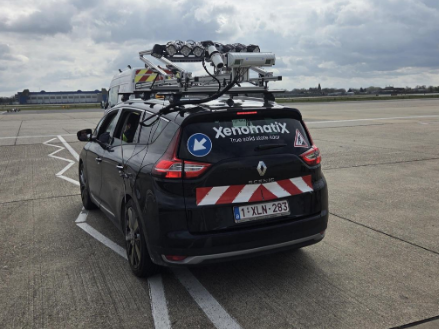
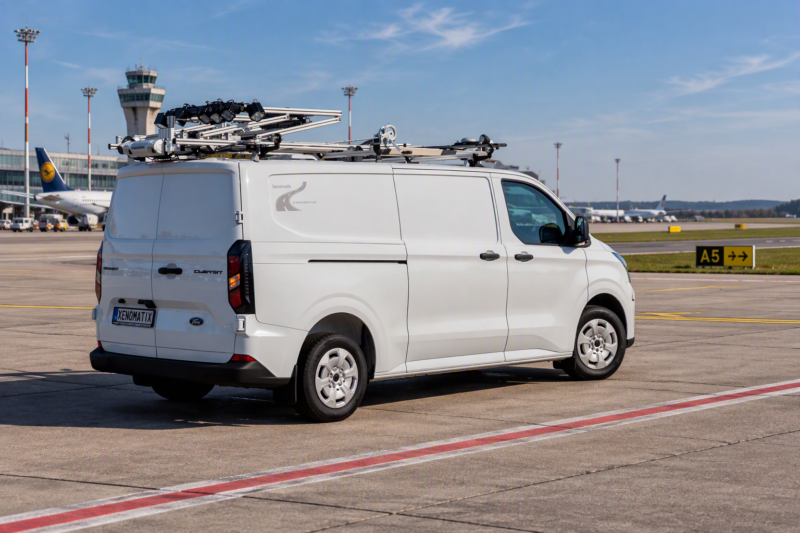
6d road scanning for airport runways, combines LiDAR, camera and GNSS into an integrated pavement inspection system that transforms a vehicle into a surveying platform.
Mounted on any vehicle, 6D Road Scanning collects detailed information about pavement condition and reveals even the smallest cracks on the surface, creating a precise digital representation of the pavement surface and identifying millimetre-level variations, including:
- Cracks and potholes
- Rutting and raveling
- Surface deformations and depressions
- Other pavement distresses
- Light fixture protrusions
The data processed provides key pavement condition indicators such as PCI, rutting and IRI, together with detailed mapping of detected defects in accordance with ASTM D5340 for airport pavements. Every detected defect can be linked to its precise location on the runway. Airport operators can see not only what is wrong, but where it is, what type of defect is present, and where maintenance attention may be required.
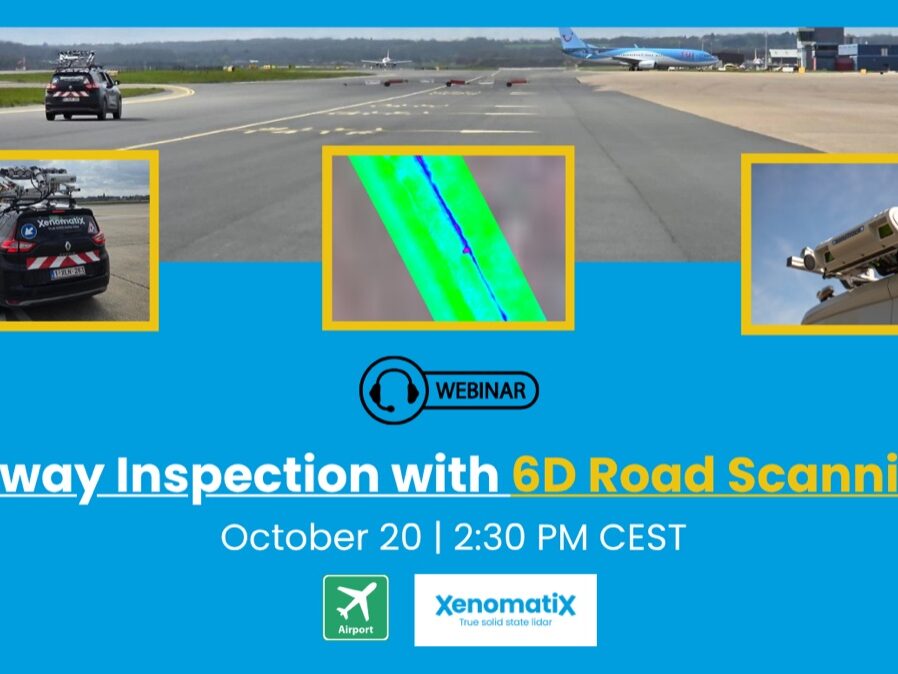
Find out more about runway inspection with XenomatiX during our webinar on October 20th, registrations here – Registration
This article was originally published by XenomatiX.