When the first Boeing 747 entered commercial service in January 1970, it introduced a new level of passenger capacity to international air travel. Pan American World Airways (Pan Am) was the launch customer, becoming the first airline to operate the aircraft commercially.
More than five decades later, the 747 is disappearing from passenger service, and its role has increasingly shifted towards cargo operations. Instead, newer twin-engine widebody aircraft have become the standard for long-haul passenger routes.
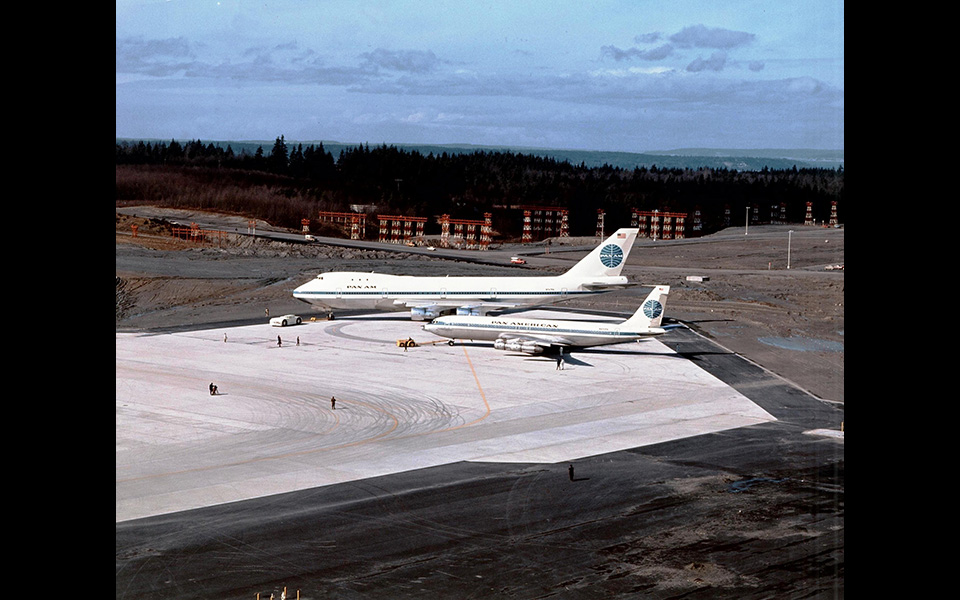
Pan Am ordered 25 Boeing 747-100 aircraft in 1966, becoming the launch customer for the new widebody jet, which had been designed around the growing demand for long-distance air travel and greater passenger capacity.
The first 747 made its maiden flight in February 1969 before entering commercial service with Pan Am less than a year later. On 22 January 1970, a Pan Am 747 operated the airline’s first scheduled 747 service between New York and London.
The aircraft’s upper deck, four engines and large fuselage made the 747 recognisable around the world. For airlines, its size provided the capacity needed for international routes with higher demand. For passengers, the introduction coincided with the expansion of mass international air travel.
However, the 747’s dominance did not last indefinitely. As aircraft technology developed, airlines increasingly adopted twin-engine widebodies. Aircraft such as the Boeing 777 and 787, along with the Airbus A330 and A350, could offer long-range operations without the four engines of the 747.
Improvements in engine reliability and regulations governing long-range twin-engine operations made it possible for aircraft such as the 777, 787 and A350 to serve routes that had previously favoured four-engine aircraft. Their lower fuel consumption made twin-engine aircraft increasingly attractive to airlines, particularly as fuel efficiency became a greater consideration.
The COVID-19 pandemic further accelerated the retirement of many remaining passenger 747s, as airlines reduced capacity and reassessed the economics of older four-engine aircraft. Airlines including British Airways, Qantas, KLM and Virgin Atlantic brought forward the retirement of their passenger 747 fleets.
Passenger 747 operations have consequently become a small part of the aircraft’s remaining role. They have nevertheless not disappeared entirely, with Lufthansa, Korean Air and Air China among the airlines that continue to operate the type.
Boeing ultimately ended production of the 747 after more than 50 years. The final aircraft, a 747-8 Freighter, was delivered to Atlas Air in January 2023. Boeing produced a total of 1,574 747s, with the fleet accumulating more than 118 million flight hours.
Now, although new 747s are no longer being built, the aircraft continues to have a role in air cargo. The 747’s large capacity and nose-loading capability have helped make it useful for freight operations, meaning the aircraft’s commercial life has continued.
However, today’s passenger airlines have increasingly favoured smaller and more efficient widebody aircraft that can operate long-haul routes with fewer passengers while offering greater flexibility in network planning. As such, the 747 aircraft, which once represented the future of long-distance passenger travel, has become a much less common sight at airports.
Pan Am itself ceased operations in 1991, but the brand has recently been associated with plans for a proposed airline revival.