Airport projects start with a future vision, where passenger numbers are forecast, masterplans are drawn up, and billions of dollars are committed to new infrastructure to meet the growing demand for air travel.
Yet according to Pittsburgh International Airport CEO Christina Cassotis, an important part of the process arises before discussing terminal capacity, gates or technology. Instead, she asks a series of simple questions: “What’s broken? What are the pain points? And how can we efficiently fix them?”
This approach has arguably shaped Pittsburgh International Airport’s recent successes, from its terminal redevelopment to its investment in energy resilience.
Rather than viewing passenger experience and operational efficiency as competing priorities, Cassotis argued that they are fundamentally linked. Designing around the people who use an airport, including passengers, employees, airline partners and contractors, is in itself an operational exercise.
Frequently, airport projects are discussed in terms of throughput, capacity and efficiency. Passenger experience is then presented as an additional benefit that can be delivered once these operational objectives are met. For Cassotis, however, reducing stress, creating intuitive spaces and making buildings easier to navigate are themselves operational improvements, and these experiences are arguably what make airports operate efficiently in the first place.
Cassotis said:If you actually do improve the passenger experience, you are optimising, If you don't start with what makes sense for the people who need the facility to work for them – whether they're travelling through it, working in it or partnering with it – I don't think you can optimise efficiently. You end up creating inefficiencies because you have to backpedal.
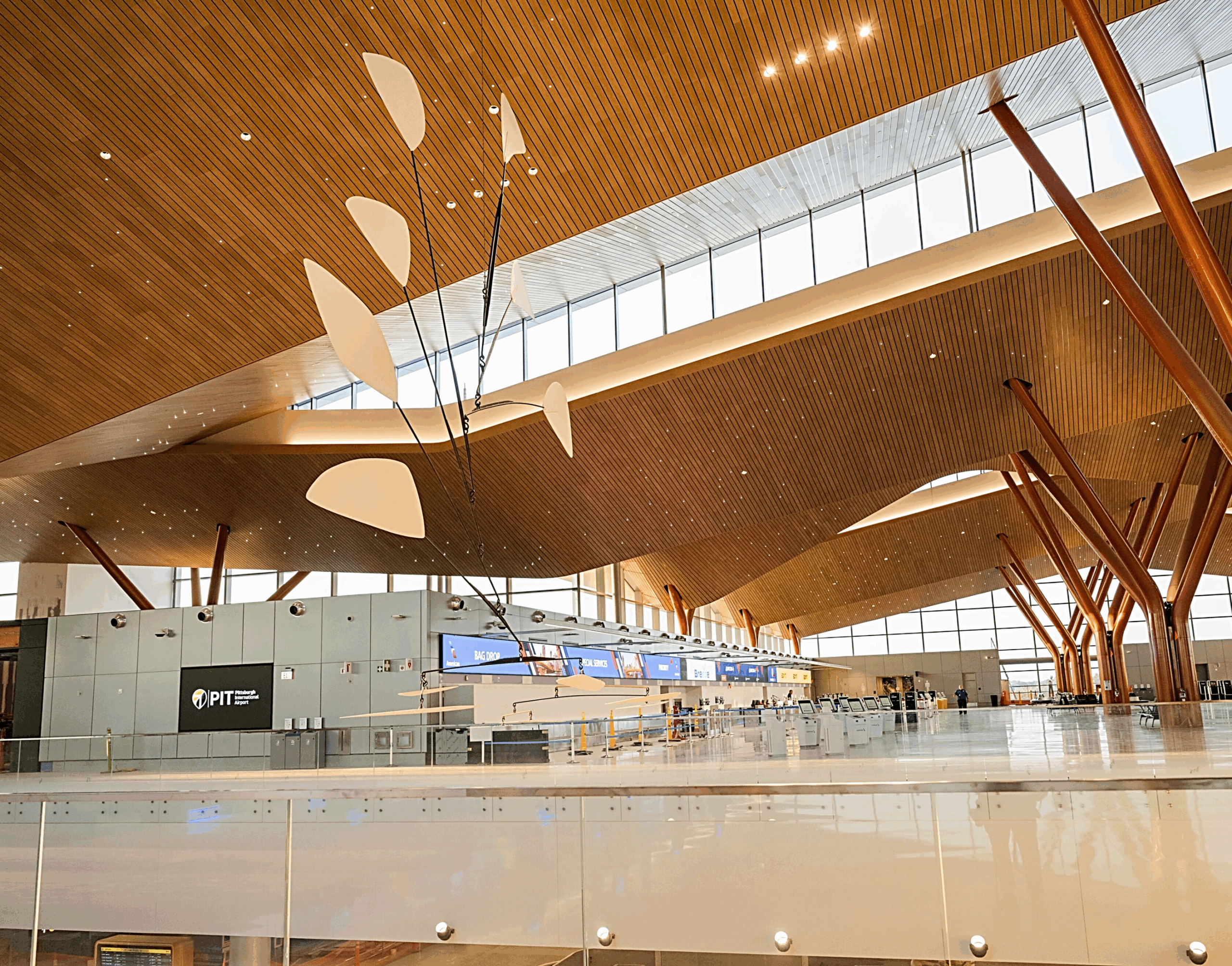
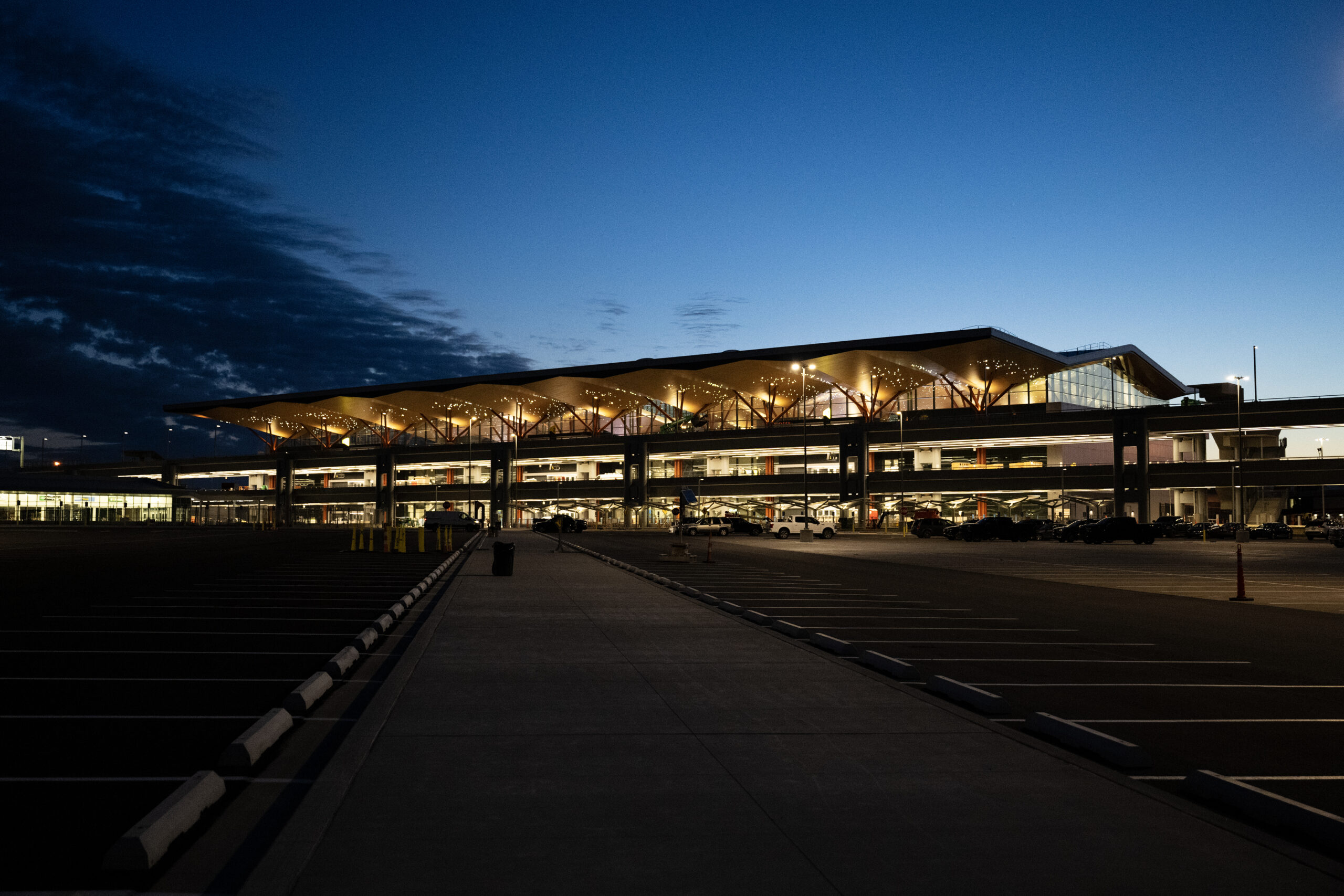
This philosophy is visible throughout Pittsburgh International Airport’s new terminal, which opened in late 2025.
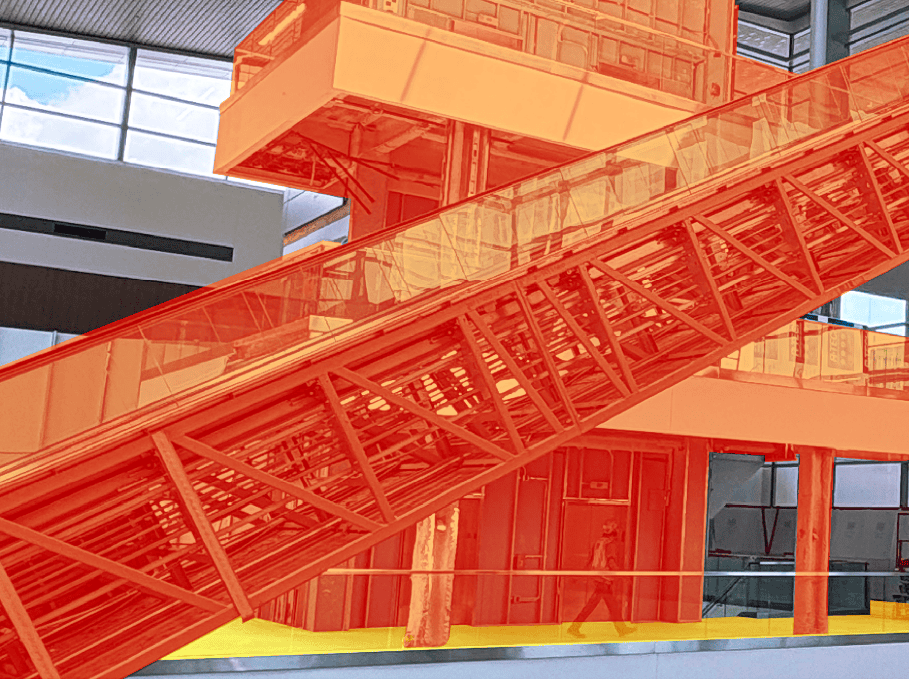
Here, visitors immediately notice the generous use of space. Natural light enters through the terminal’s distinctive rolling roof, while an open central atrium creates clear sightlines between departures and arrivals. In addition, a single security checkpoint replaces the previous two, simplifying passenger flows.
However, when describing these features in an interview with Airport Industry-News, Cassotis rarely spoke about architecture. Rather, she talked about how the building feels to the passengers. For example, the decision to leave large open spaces was driven by practical considerations rather than merely visual impact.
Cassotis reflected:If you think about a whole bunch of flights arriving at once... there's plenty of room for meeters and greeters to find you and for the Love Actually reunions to take place without feeling like you're being squished.
Cassotis’focus repeatedly returned to a consistently human way of describing airport infrastructure. Rather than talking about passenger processing rates or circulation modelling, Cassotis describes the experience of moving through a building.
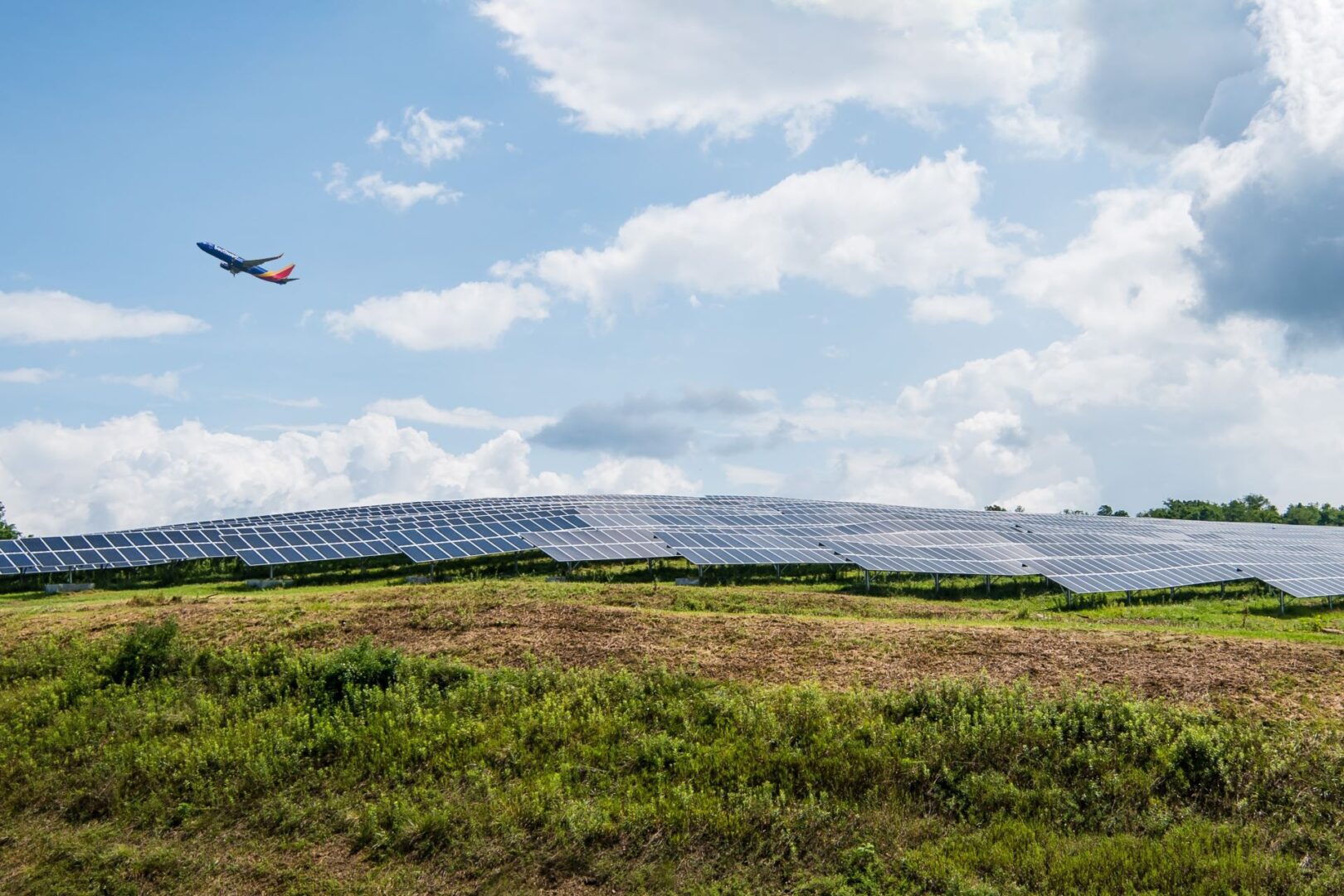
Interestingly, this mindset also extends beyond the terminal. When discussing Pittsburgh’s on-site microgrid, which has been powering the airport since 2021, Cassotis did not begin with carbon reduction or energy innovation. Instead, she recalled the major power failures at Los Angeles International Airport and Hartsfield-Jackson Atlanta International Airport that significantly impacted passengers and prompted Pittsburgh to rethink its resilience.
The airport subsequently developed a public-private partnership to create a microgrid capable of supplying enough electricity to maintain airport operations independently of the regional grid.
The value of this system became particularly apparent when a substation fire caused a power disruption, shortly before Heathrow Airport experienced its own widely reported outage due to a similar incident.
Cassotis explained:Two weeks before Heathrow lost power, we had the same issue with a fire at a substation and our microgrid kicked into island mode. The lights flickered, and nothing else happened to disrupt operations.
Cassotis did note that the microgrid has also delivered cost savings and reduced carbon emissions. However, she emphasised that resilience was always the primary objective.
Instead of discussing the technology in isolation, she explained how maintaining power protects the people and services that depend on the airport. Pittsburgh is home to one of the US’ leading transplant centres, with donor organs regularly arriving by air for life-saving procedures. Ensuring the airport remains operational during a power outage therefore extends beyond keeping flights on schedule; it also helps safeguard access to critical healthcare.
Cassotis added:We wanted to make sure that we were staying open and that everybody was going to get what they needed. That was actually a really big motivator for us – to take care of our region and the people who rely on it.
As such, the conversation consistently returned to people before infrastructure. The microgrid was not presented as an engineering achievement or a sustainability project first and foremost, but as a means of ensuring the airport could continue serving its community when it mattered most.
Just as Pittsburgh’s terminal design began by asking how the airport could work better for its users, its sustainability ambitions begin by asking how the airport can create greater value for the wider aviation sector. This includes the exploration of producing sustainable aviation fuel (SAF). Here, Cassotis sees fuel production as an opportunity for airports to further contribute to the industry through collaboration, using their land, infrastructure and regional partnerships to support the wider aviation ecosystem.
In her view, drawing clear boundaries between where an airport’s responsibilities end and an airline’s begin risks overlooking opportunities to deliver greater value together.
Cassotis said:I don't know that there's a hard line between airports and airlines. I think we all need to be working together a lot better, and I think that by saying, 'This is my job and that's yours,' is not going to get us anywhere. People are doing what they can to maximise in their own areas, but when we work together, there's even more opportunity.
Cassotis focus was less on the technology itself than on the relationships needed to deliver it. Whether discussing terminal design, energy resilience or sustainable aviation fuel, Cassotis repeatedly returned to the idea that airports achieve more when they stop treating infrastructure, operations and sustainability as separate objectives and instead approach them as shared challenges across the aviation industry.
Notably, Pittsburgh has also deliberately built flexibility into its new terminal, acknowledging that it cannot predict precisely what aviation will look like in the region in 20 or 30 years. When asked what she hoped Pittsburgh International Airport would be known for in another decade, Cassotis’ answer reflected that same willingness to embrace uncertainty.
Cassotis asserted:In 10 years, I would hope that Pittsburgh is known for being fearless in exploring where the airport could go and who it can work with in order to really deliver more value than anybody expected to the region and to the industry.
I hope in 10 years I'm walking through thinking, 'Oh my gosh, I never would have thought of that. Isn't that great?'
I hope that I land at other airports and I see suites of sensory rooms, and I hope I understand there's a microgrid running their infrastructure. I hope I see more spaces where everybody can navigate easily.
That's what I really hope—that there's an impact on the industry, and that it continues to be felt here.
The most successful infrastructure projects may therefore not predict every future trend. Instead, they begin by asking the right questions, solving today’s problems thoughtfully and leaving enough flexibility to accommodate ideas that have yet to emerge. Perhaps designing airports “backwards” simply means starting where passengers do.
Listen to the full interview in our latest episode of All Routes Considered: